(bi-)Carbonate electrolytes not only help maintain a stable pH in our bodies, but they are also frequently used in electrolysers for similar reasons. A near-neutral pH helps suppress hydrogen production in CO2 electrolysers or oxygen production during hydrogen peroxide synthesis.
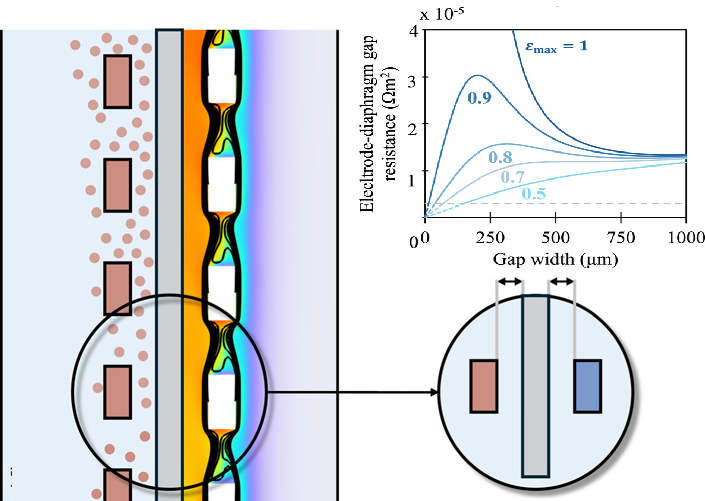
An often-overlooked downside is that, over minutes to hours, diffusive transport through the diaphragm becomes insufficient to replenish the hydroxide ions consumed. This will cause carbonate to convert to bicarbonate, then to CO2, which may be removed from the system as gas bubbles.
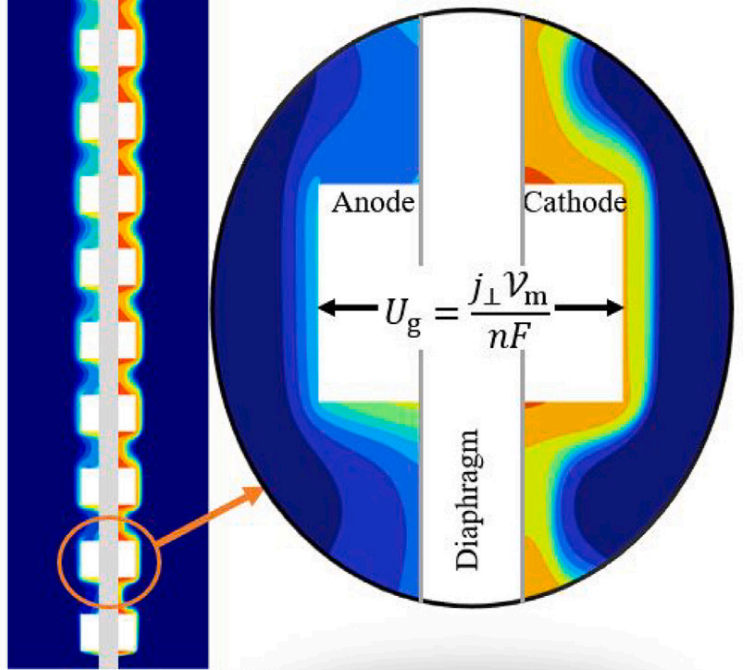
We conducted experiments and developed a computational model that enables us to quantitatively understand and predict these coupled phenomena. The work combines mass transport, fluid dynamics, solution chemistry, and electrochemistry into an integrated picture of the system.
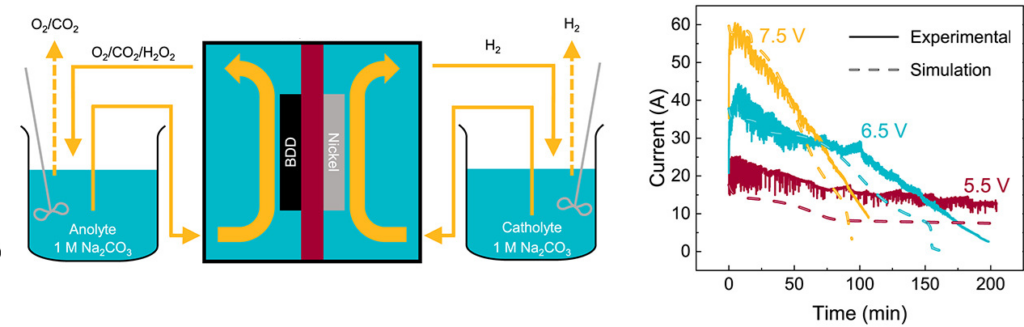
In lab experiments, this problem is often avoided by focusing on relatively short measurement times. Or, the anolyte and catholyte are continuously recombined, neutralising the pH. The latter solution will, in general, only be possible if there are no products that cannot be mixed. This, in turn, shows the importance of effective in-line separation. Ideally, however, membranes are developed that avoid this problem altogether.